Research
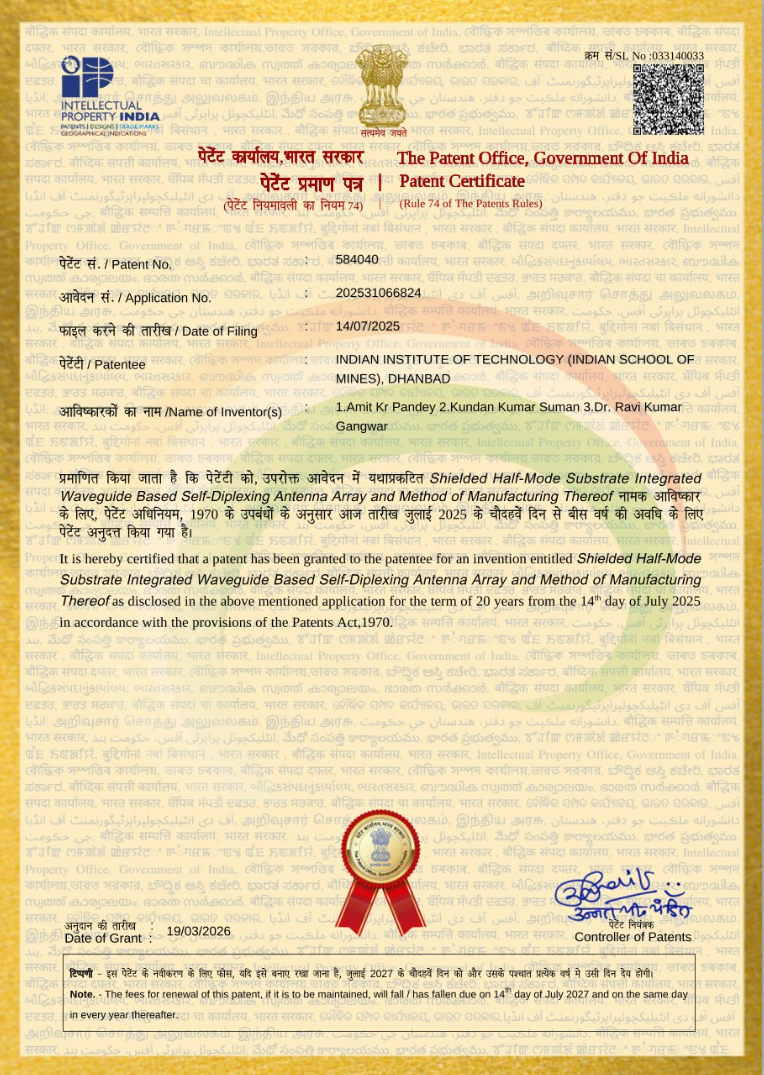
The new patent is awarded to Prof. Ravi Kumar Gangwar and his group.
“Patent Grant” titled “Shielded Half-Mode Substrate Integrated Waveguide-Based Self-Diplexing Antenna Array and Method of Manufacturing Thereof”, granted by the Intellectual Property Office, India (Patent No. IN584040 B1), effective from March 2026, developed by the inventors Mr. Amit Kr Pandey, Dr. Kundan Kumar Suman, and Prof. Ravi Kumar Gangwar.
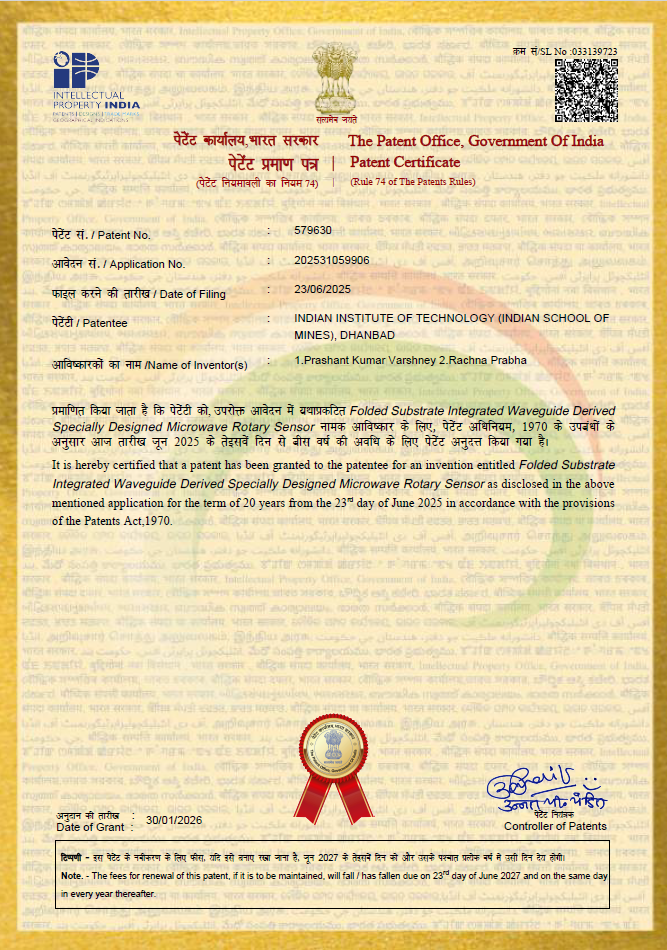
The new patent is awarded to Prof. Prashant Kumar Varshney and his Scholar
“Patent Grant” titled “Folded Substrate Integrated Waveguide Derived Specially Designed Microwave Rotary Sensor” with grant no. 579630 effective from June 2025, developed by the inventors, Prof. Prashant Kumar Varshney and his research scholar Ms. Rachna Prabha.
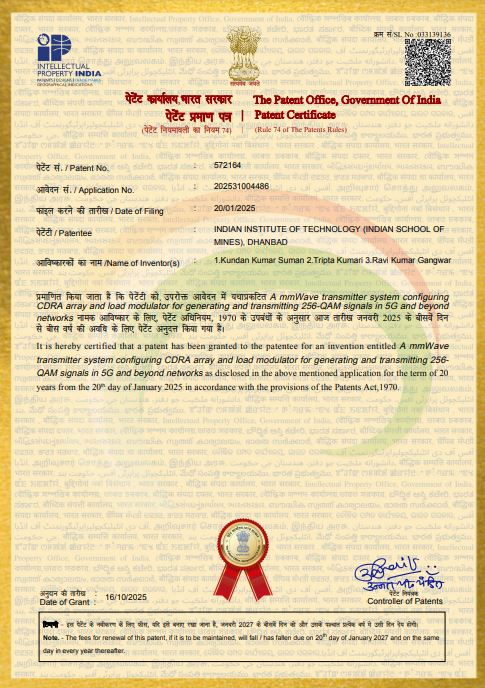
The successful acquisition of the recent patent by Prof. Ravi Kumar Gangwar and his team.
This patent discloses a compact circularly polarized (CP) four-port multiple-input multiple-output antenna system developed using a dielectric resonator and integrated with a 3D-printed PLA radome for unmanned aerial vehicle (UAV) video transmission. The design employs open-loop conformal strips with lateral metallic strips to generate CP radiation, while a novel decoupling structure consisting of a cross-stub with a central ring and a labyrinth-shaped defected ground structure significantly enhances inter-port isolation (>16.8 dB). Operating in the 5.7–5.9 GHz band, the antenna achieves a measured gain of about 5.5 dBic with efficiency exceeding 90%, ensuring robust performance against multipath effects. The radome not only protects the antenna in harsh environments but also preserves aerodynamic stability, making the system highly suitable for reliable UAV-based video and communication applications.
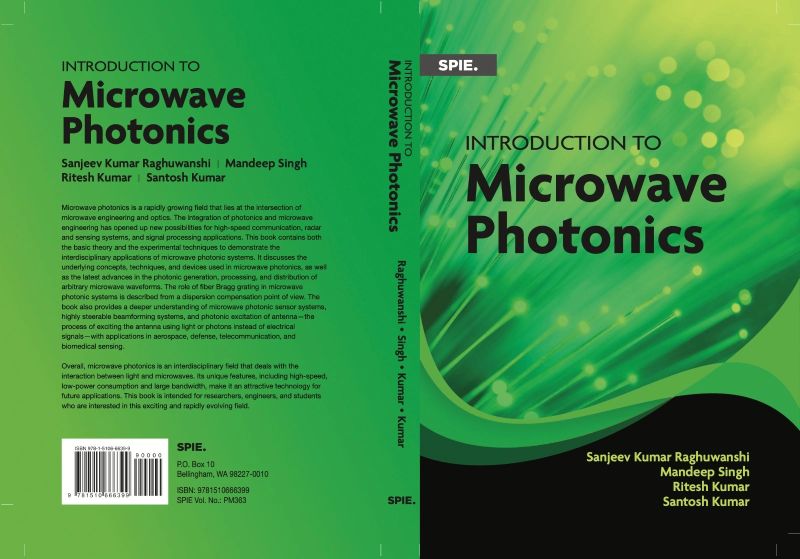
Prof. Sanjeev Kumar Raghuwanshi, Department of Electronics Engineering, has co-authored the book “Introduction to Microwave Photonics”, published by SPIE – the International Society for Optics and Photonics, under its prestigious PM Series (PM363)
The book explores groundbreaking concepts in microwave photonics, bridging microwave engineering and photonics, with applications in high-speed communications, radar, aerospace, defense, biomedical sensing, and signal processing.
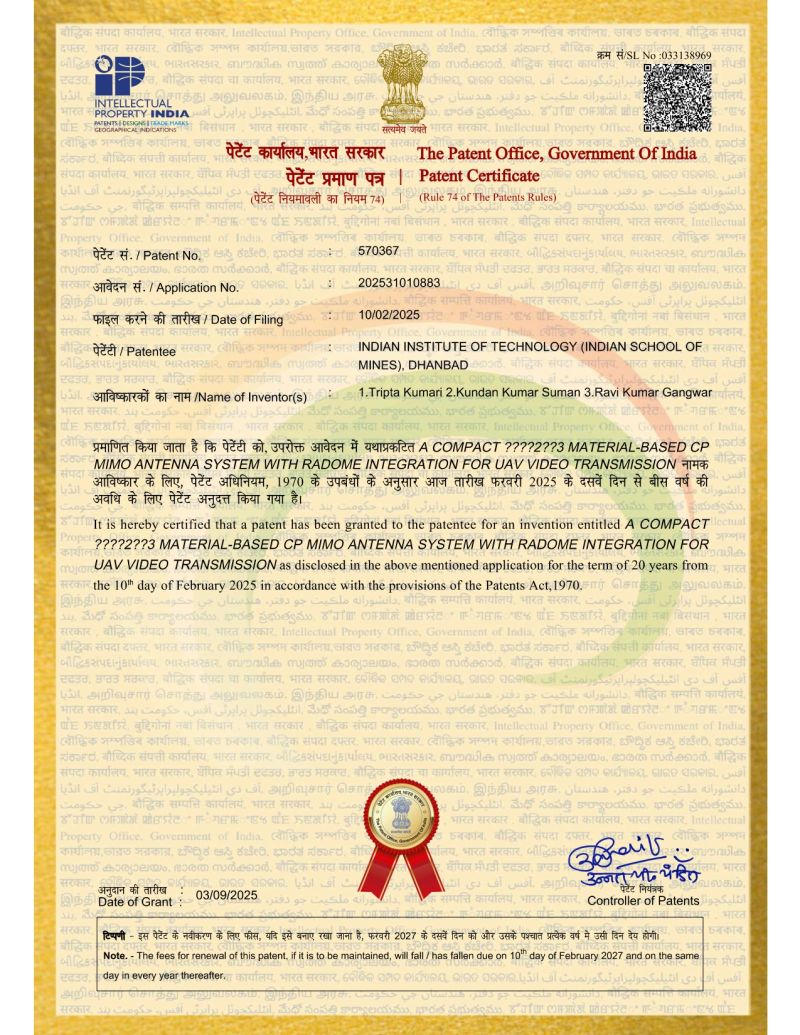
The new patent is awarded to Prof. Ravi Kumar Gangwar and his group.
This patent discloses a compact circularly polarized (CP) four-port multiple-input multiple-output antenna system developed using an dielectric resonator and integrated with a 3D-printed PLA radome for unmanned aerial vehicle (UAV) video transmission. The design employs open-loop conformal strips with lateral metallic strips to generate CP radiation, while a novel decoupling structure consisting of a cross-stub with a central ring and a labyrinth-shaped defected ground structure significantly enhances inter-port isolation (>16.8 dB). Operating in the 5.7–5.9 GHz band, the antenna achieves a measured gain of about 5.5 dBic with efficiency exceeding 90%, ensuring robust performance against multipath effects. The radome not only protects the antenna in harsh environments but also preserves aerodynamic stability, making the system highly suitable for reliable UAV-based video and communication applications.
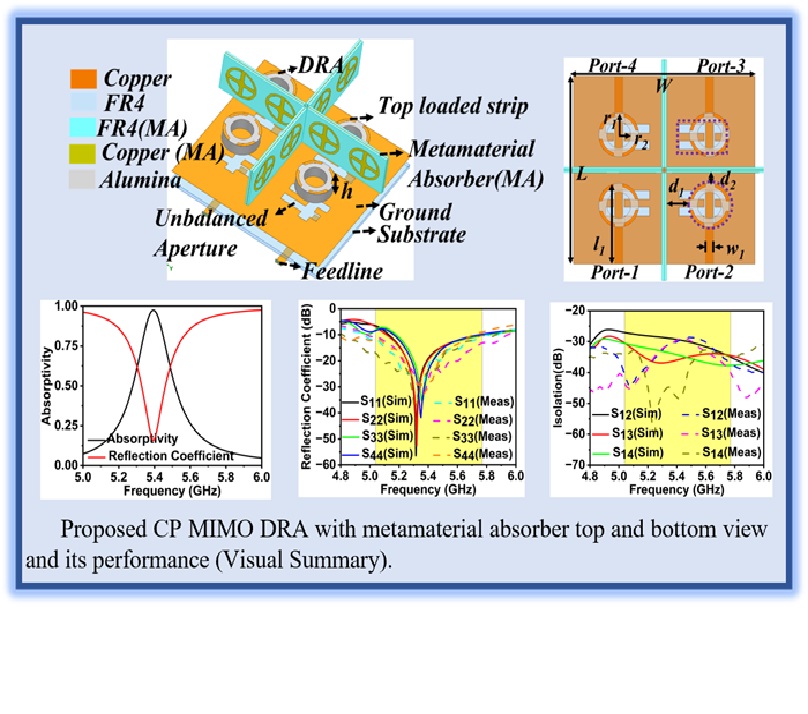
Metamaterial Absorber-Integrated CP MIMO DRA for EMI Reduction and High Isolation,” Published in IEEE Letters on Electromagnetic Compatibility Practice and Applications
A quad-port circularly polarized MIMO dielectric resonator antenna (DRA) is proposed with an integrated metamaterial absorber (MA) to combat electromagnetic interference (EMI) and enhance inter-element isolation. The ring DRA is excited using an unbalanced aperture and conformal arc strips, generating left-hand CP radiation at 5.3 GHz. A vertical 1×2 MA array featuring a hexagonal cross-ring structure, achieves >93% absorption and improves isolation from −12 dB to −28 dB within 5.1–5.7 GHz. Equivalent circuit modeling and material characterization validate absorption behavior. The fabricated antenna shows wide impedance and AR bandwidth, high gain (~5 dB), excellent diversity performance (ECC < 0.01), and ~90% radiation efficiency, making it ideal for EMI-sensitive WLAN and Wi-Fi environments.
Read More
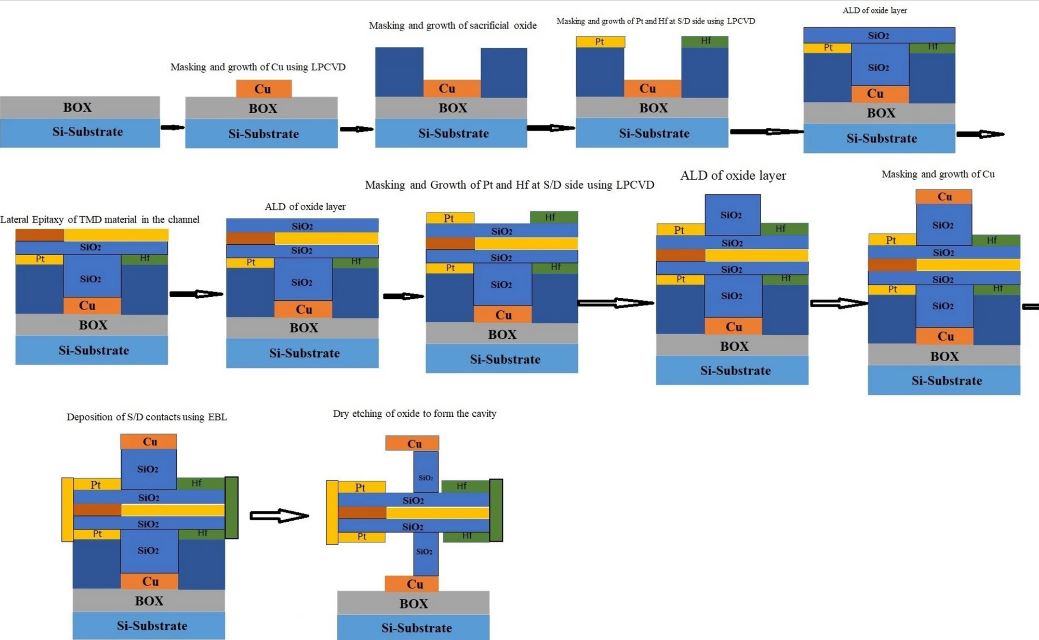
Design and investigation of charge plasma-based TMD heterojunction TFET biosensor for ultrasensitive detection
In this work, a charge plasma TMD heterojunction tunnel FET-based dielectrically modulated biosensor is designed and investigated for biosensing applications. In the proposed biosensor, WTe2 and MoS2 serve as the source and channel material, respectively to form the heterojunction. Whereas the channel-drain junction is a homojunction formed by MoS2. The advantage of heterojunction has been exploited to overcome the low ION and ambipolar behavior of TFET, which results in the enhancement of sensitivity. The charge plasma doping has been utilized to mitigate random dopant variations, reduce manufacturing expenses, and simplify the fabrication process. Non-equilibrium green’s function (NEGF)-based simulator and SILVACO TCAD, a 2-D device simulator have been utilized to simulate the electrical characteristics of the proposed biosensor. Finally, the proposed biosensor is benchmarked with contemporary works of the literature and it has been observed that the presented charge plasma TMD heterojunction TFET (CP-TMD-HJ-TFET)-based biosensor has emerged to have a superior sensitivity (i.e. ION/IOFF ratio) which is ∼ 4 decades higher than the maximum sensitivity reported by any contemporary biosensor.
Read More